
 The Standard Group Plc is a multi-media organization with investments in media
platforms spanning newspaper print
operations, television, radio broadcasting, digital and online services. The
Standard Group is recognized as a
leading multi-media house in Kenya with a key influence in matters of national
and international interest.

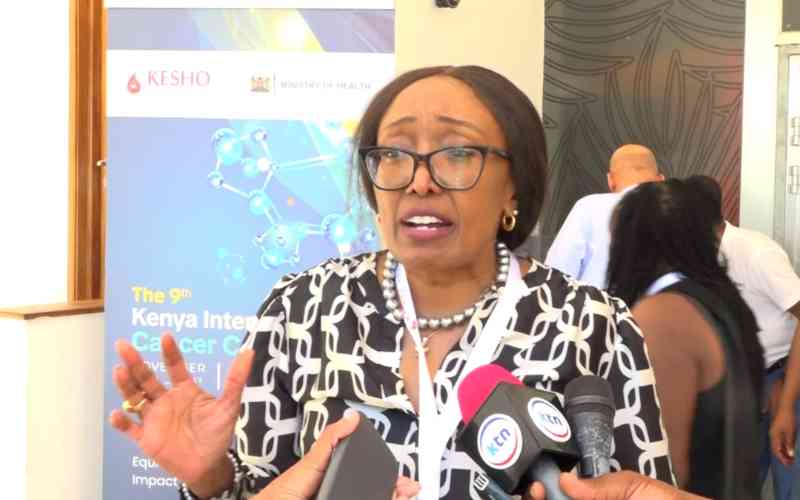
Medical practitioners have been urged to embrace Artificial Intelligence (AI) in oncology to enhance early cancer diagnosis and treatment as the country continues to grapple with a rising cancer burden.
According to estimates by the Global Cancer Observatory (GLOBOCAN) 2024, Kenya records approximately 35,867 new cancer cases annually, while 22,888 people succumb to the disease every year.
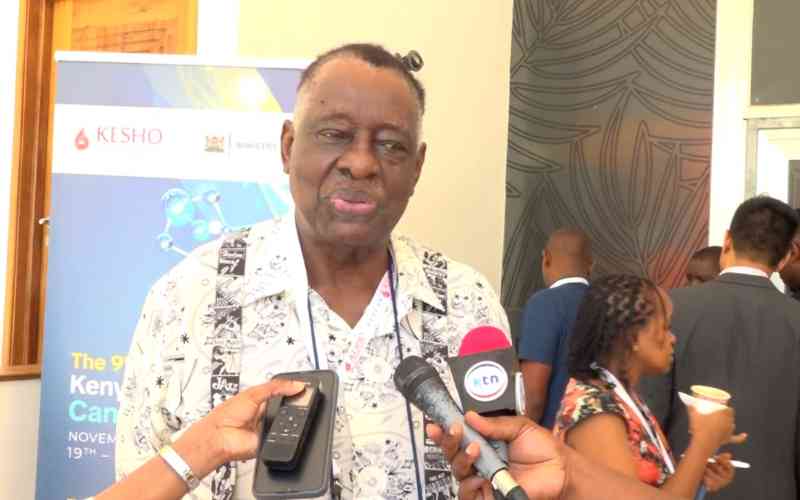
Speaking in Mombasa during the 9th Kenya International Cancer Conference, organised by the Kenya Society of Haematology and Oncology (KESHO), Prof Joseph Aluoch, a said AI was poised to transform medicine and improve lives, urging healthcare professionals to embrace the technology.
Prof Alouch, a veteran physician with 58 years of experience emphasised that AI plays a critical role in enhancing diagnostic accuracy, enabling early detection of diseases and minimising medical errors.
“AI-powered pathology and predictive analysis systems could play a significant role in detecting cancer at its earliest stages. For instance, in cervical cancer AI can analyse cells and blood samples collected through Pap smear tests to identify abnormalities earlier than conventional visual examinations,” said Prof. Aluoch.
He challenged healthcare facilities to strengthen their Electronic Health Records (EHR) systems to facilitate the effective use of AI and improve interoperability across health institutions.
“You may have your data in Mombasa; the next time you go to Kisumu, you will be seen by another doctor, which is typical of Kenya. If no system can transfer the data in Mombasa or connect the data in Mombasa to Kisumu, then AI is not going to be very useful,” explained Prof Aluoch.
He noted that unlike human practitioners, AI does not experience burnout and can efficiently handle repetitive tasks over extended periods.
The Professor said that AI is just a tool that will help doctors work better rather than replace them.
However, Prof Aluoch said that doctors who do not embrace AI will be replaced by those who are familiar with AI.
He said that AI relies on data generated by healthcare systems and cannot independently create the information required for effective analysis.
“AI is very important, but what you don’t realise is that it cannot translate. It’s not like a big computer that you bring from London, and you sit here. AI’s main work is to analyse data; it doesn’t do anything; it doesn’t create the data, so you have to produce your data yourself,” said Prof Aluoch.
Prof Aluoch also called for the ethical application of AI in healthcare, emphasising that the technology should support rather than replace medical professionals in making critical decisions.
He said AI is similar to a navigation system that provides alternative routes but leaves the final choice to the user, cautioning that its growing application in healthcare also raises important ethical concerns.
“It doesn’t force you to make any decision. But there are a lot of so-called challenges. I talked about opportunities in AI, but there are also, ethical challenges,” stated Prof. Aluoch.
KESHO President Dr Gladwell Kiarie urged the government to take advantage of the bulk purchase of the cancer drugs to secure discounted price that will ease the cost burden on patients.
“SHA should say I bring you most patient, give me a discount and translate the discount to the patient. We need to get imaginative and aggressive,” said Dr Kiarie.
She called for increased investment in technology, improved health financing and stronger policy frameworks to ensure patients across Kenya have equal access to quality cancer diagnosis and treatment.
Dr Kiarie said access to cancer care remains uneven, with patients in rural and marginalised areas facing challenges accessing specialised services due to financial constraints and limited medical facilities.
She further said AI had become an important component of modern medical practice, helping to improve diagnostic accuracy and reduce turnaround times.
“AI is being used in multidisciplinary team meetings; it is being used in diagnostics; it’s being used in treatment, and all this is keeping up with the times,” said Dr Kiarie.
The three-day conference, themed “Equity, Excellence and Sustainable Impact in Cancer Care,” has attracted more than 600 participants from Kenya, Tanzania, Uganda and South Sudan.






 join
