×

The Standard e-Paper
Home To Bold Columnists
 The Standard Group Plc is a
multi-media organization with investments in media platforms spanning newspaper
print operations, television, radio broadcasting, digital and online services. The
Standard Group is recognized as a leading multi-media house in Kenya with a key
influence in matters of national and international interest.
The Standard Group Plc is a
multi-media organization with investments in media platforms spanning newspaper
print operations, television, radio broadcasting, digital and online services. The
Standard Group is recognized as a leading multi-media house in Kenya with a key
influence in matters of national and international interest.

Audio By Vocalize

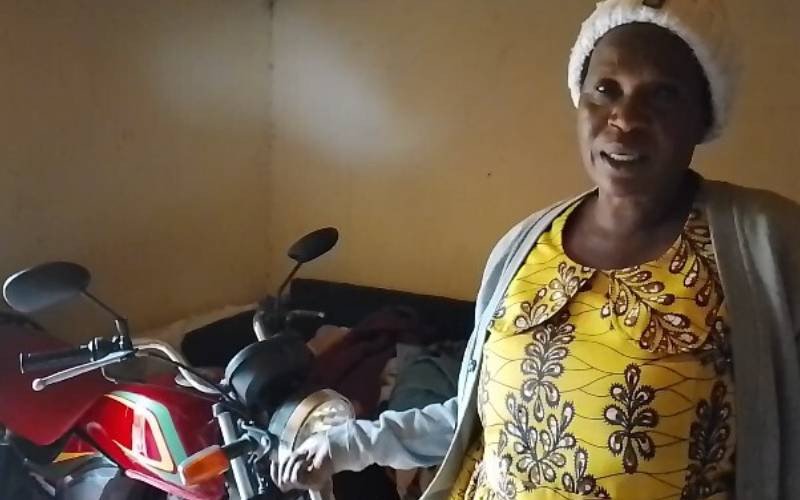
Rebecca can now continuously harvest cowpeas for over six months, thanks to smart technologies. [Courtesy]
Across Kenya's Arid and Semi-Arid Lands (ASALs), farming has long been a struggle amid harsh weather conditions often characterised by prolonged hot and dry periods.
For many decades, food aid became a familiar response, especially whenever an acute drought struck.
In Makindu, Makueni County, a gradual transformation is taking place, thanks to the introduction and subsequent adoption of smart farming technologies, which are proving that even dry areas can be productive and enhance food security.
By using technologies such as ripping to break hard soil pans, zai pits for water harvesting, mulching, crop diversification, and the use of climate and weather advisories while making relevant farming decisions, farmers are beating hunger, season by season.
While this region, like other ASALs in Kenya, has barely been linked with food production, farmers are proving that with the right knowledge, technologies, financing, and climate information, they can build resilient livelihoods and produce enough food even under challenging conditions.
Josephine Mwende, a farmer, recalls the moment she decided she no longer wanted her family to depend on relief food.

Josephine Mwende displays her maize crop nearing harvest in Makindu, Makueni County, where she has adopted zai pits. [Courtesy]
Years ago, a neighbour was charged with listing the needy members of the community who would receive relief food. It was during a drought, and her family barely had any food.
“Although my neighbour was rich, she listed herself as the number one beneficiary, followed by other neighbours, while my name was vividly missing,” recalls Josephine. Her efforts to seek intervention from the area chief were futile as she was casually dismissed.
“This experience was not just painful and shameful but also transformative. Every time I hear that there is relief food distribution, I head right to my farm and start working,” says Josephine.
For Rebecca Kioko, ripping has been one of the most transformative innovations. This is a technology that breaks the hardpan beneath the soil surface, allowing rainwater to infiltrate and remain available to crops for much longer.
"Before ripping, my cowpea crops would only survive between April and June. Now the soil stores moisture much longer, and crops can continue utilising water and yielding up to October or even beyond,” she says, adding that she used to harvest about two bags of maize but now expects six bags from the same piece of land.
Characterised by maize, bananas, cowpeas, citrus, guava, and other crops, her farm tells a story of resilience and demonstrates that crop diversification is possible in the ASALs.
Stay informed. Subscribe to our newsletter
These are among the farmers who have adopted climate-smart technologies that are placing ASAL Makueni as a breadbasket for communities locally and beyond.
Through the World Bank-funded CGIAR Climate Research for Africa (AICCRA) project, local communities have been introduced to climate-smart agriculture technologies.
At the heart of this transformation is Kimatwa Women's Sacco, a farmer-led cooperative that has become a model for scaling agricultural innovations in Makueni and beyond.
Working with scientists and other experts, mainly from the Alliance of Bioversity International and CIAT, the Sacco members have since become not just champions but agents of transformation.
At the Makindu ASK showground, the Sacco has a demo farm where they showcase different technologies that they have learned through AICCRA.
“We requested to be allocated space at the ASK ground so that we can amplify the reality of smart technologies to farmers beyond our Sacco members,” says Teresa Ngonze, the chairperson of the Kimatwa Women Sacco.
Through the Sacco, she adds, farmers have access to the financing, training and support needed to adopt these technologies. Agriculture loans are offered at a reducing balance of two per cent, and a credit committee ensures the loan is not just utilised in farming-related investments but also repaid in an appropriate time.
Since the interventions, the members started learning, adopting and scaling smart farming technologies; membership has grown from 600 to 870, thanks to technologies that have proved impactful.
“As community members learn from our farmers, they not only adopt the technologies but also join the Sacco, so we grow together as a community,” says Teresa.
Across Africa’s ASALs, over 255 million people face hunger, while ASALs account for 60-70 per cent of the continent, according to the principal scientist at the Alliance of Bioversity International and CIAT and director of AICCRA, Dr Robert Zougmore.
“While ASALs are often associated with livestock keeping, they are increasingly significant for crop production and subsequent food security, thanks to technologies,” says Zougmore.
However, he notes that adoption of suitable technologies remains low at 30 per cent, citing technical, economic and socio-cultural barriers. Women and youth, he adds, should be actively involved in adopting technologies, as this would double or even triple output.
World Bank Technical Team Lead-AICCRA, Viviana Perego, hailed investment in agriculture, saying that each USD invested in agricultural research delivers 10 USD in return at present value.
“Investing in agricultural systems is key to improving food and nutrition security as well as the management of climate change and its effects,” she says.
She called for strong partnerships among stakeholders, including governments, the private sector, development partners, and academia, among others, emphasising that each has a role and that joint efforts would bring about great impact.





Subscribe to our newsletter and stay updated on the latest developments and special offers!








 join
join